
The term comes from the product software market, where it usually describes a layer that sits on top of a product information system. The idea behind it is older and simpler. The same product has to make sense on your own site, in a Google Shopping ad, on a marketplace and inside an assistant’s answer, and each of those places reads it differently.
What does a product experience include?
A product experience is everything a shopper or a machine can learn about a product before buying it. Some of it is words, some is images, and a growing share is structured fields that only software reads.
| Part of the experience | Where it shows up | What goes wrong without PXM |
|---|---|---|
| Title | Search results, ads, marketplace listings | One title is forced to fit every channel’s length limit and search habits |
| Description and highlights | Product pages, feeds, assistant answers | Copy written for the website is cut off or ignored elsewhere |
| Attributes | Filters, ad matching, AI answers | Values differ by channel, or are missing in the channel that needed them |
| Images and video | Every channel, in different crops and orders | The lead image suits one channel and fails another |
| Price and availability | Ads, listings, checkout | A stale price in one channel triggers disapprovals or lost trust |
| Reviews and questions | Product pages, some ad formats | Real shopper language never reaches the record |
The table shows why PXM is a coordination job. Most of these parts are owned by different teams, and the shopper sees all of them at once.
Who reads the product experience now?
For most of ecommerce’s history, the reader was a person looking at a page. Today a large share of the first reading is done by software: search engines, ad systems and AI assistants decide which products to show before a person sees anything.
Those readers don’t look at your layout. They read fields. The schema.org vocabulary that many sites use to describe products to search engines has separate properties for color, material, size, pattern and audience, plus a general one for “a product feature” (schema.org Product). A product page can look complete to a person and still give a machine very little to match against a question like “a warm sweater for a long flight that won’t itch.” That changes what a good product experience means. It now has to be complete in text and structure, as well as in the photography and copy people see.
How is PXM different from PIM?
A PIM is where product facts are stored and approved. PXM is what you do with those facts in each channel.
| PIM | PXM | |
|---|---|---|
| Focus | The correct record | How the record is presented in each channel |
| Typical question | Is this product’s data complete and approved? | Does this product read well, and the same, everywhere it appears? |
| Output | One approved record per product | Channel-specific titles, copy, image orders and fields |
| Measured by | Completeness and accuracy | Consistency across channels, conversion and channel performance |
Neither one creates facts that nobody recorded. If the record never says a sweater is machine washable, no amount of channel tailoring can show it. That’s why teams that take PXM seriously end up looking at the record itself: which attributes it carries, and which ones shoppers ask about that it doesn’t.
How do you measure product experience management?
Measure it in two ways: whether the product says the same thing everywhere, and whether changes to it move sales against a control.
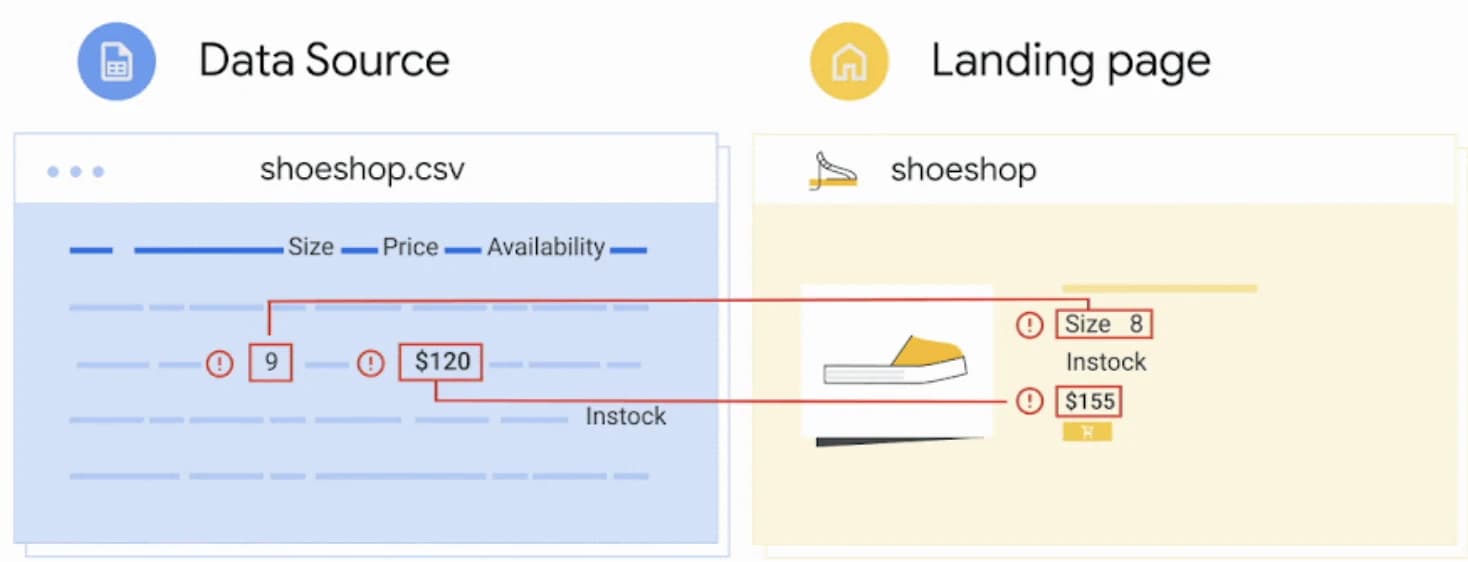
Consistency is the floor. When the price in a feed doesn’t match the product page, Google says the product “may be disapproved” and that mismatched prices “may lead to an account suspension” (Google Merchant Center Help). Our misrepresentation suspension checklist covers what to check when it gets that far. Channel requirements are the next layer, and our guide to Google Shopping feed requirements lists the fields Google needs and the ones that only help.
Performance is the real test. A new title or a richer set of attributes should be compared with an unchanged group of products over the same period, so that seasonality and ad spend don’t take the credit. That is the standard Lily Max is built around: it generates titles, descriptions, attributes and taxonomy, then measures them with matched-spend A/B tests and holdouts before your team decides what to scale. See how Lily Max works, or book a demo to see how your products read to the systems that choose them.
Frequently asked questions
What does PXM stand for?
PXM stands for product experience management. It covers how product information is presented and kept consistent across every channel where shoppers or machines encounter a product.
Is PXM the same as PIM?
No, a PIM stores and governs the product record, while PXM shapes how that record is presented in each channel. Many teams run PXM work on top of the data a PIM holds.
Why does PXM matter for AI shopping?
AI assistants and search engines read structured product fields before any shopper sees a page. A product experience that lives only in photos and page design gives those systems little to match against a shopper’s question.

See Lily in action
Book a personalized demo and see how Lily can grow your retail revenue.
Related Blogs
Product content management for AI-written copy: approvals, versions, rollback
Product content management for AI-written copy: why review comes before the full catalog runs, how every changed field is marked, and what rollback needs.
By Lily AI
What is PIM? Product Information Management vs Product Data Enrichment, and what a PIM can’t write
What is PIM? A PIM stores product data but can’t write facts nobody recorded. How it compares with enrichment, PXM, MDM and DAM, plus a checklist.
By Lily AI
Product listing optimization for AI shopping: a thin listing reads like its cheaper twin
Product listing optimization for AI shopping: put who a product is for, what it’s for and how it feels in fields machines read, or they compare only price.
By Lily AI
Google product category: 5,595 categories, and one for every shoe
Google's product taxonomy has 5,595 categories and one for every shoe. How to pick the right Google product category, with 25 examples and where it falls short.
By Lily AI
Product attributes: which ones each discovery surface reads, and what a good one looks like
Which product attributes each discovery surface reads, what a well-formed value looks like, and the 2026 Merchant Center fields to fill in first.
By Lily AI
Product Data Enrichment: What It Means When the Machines Are the Reader
Product data enrichment is not filling empty fields. Get the working definition, the four readers, the boundary with PIM, and a way to measure lift.
By Lily AI