Muse vs Instinct: what personal shopping agents mean for retailers
Part of: AI discovery and agentic commerce
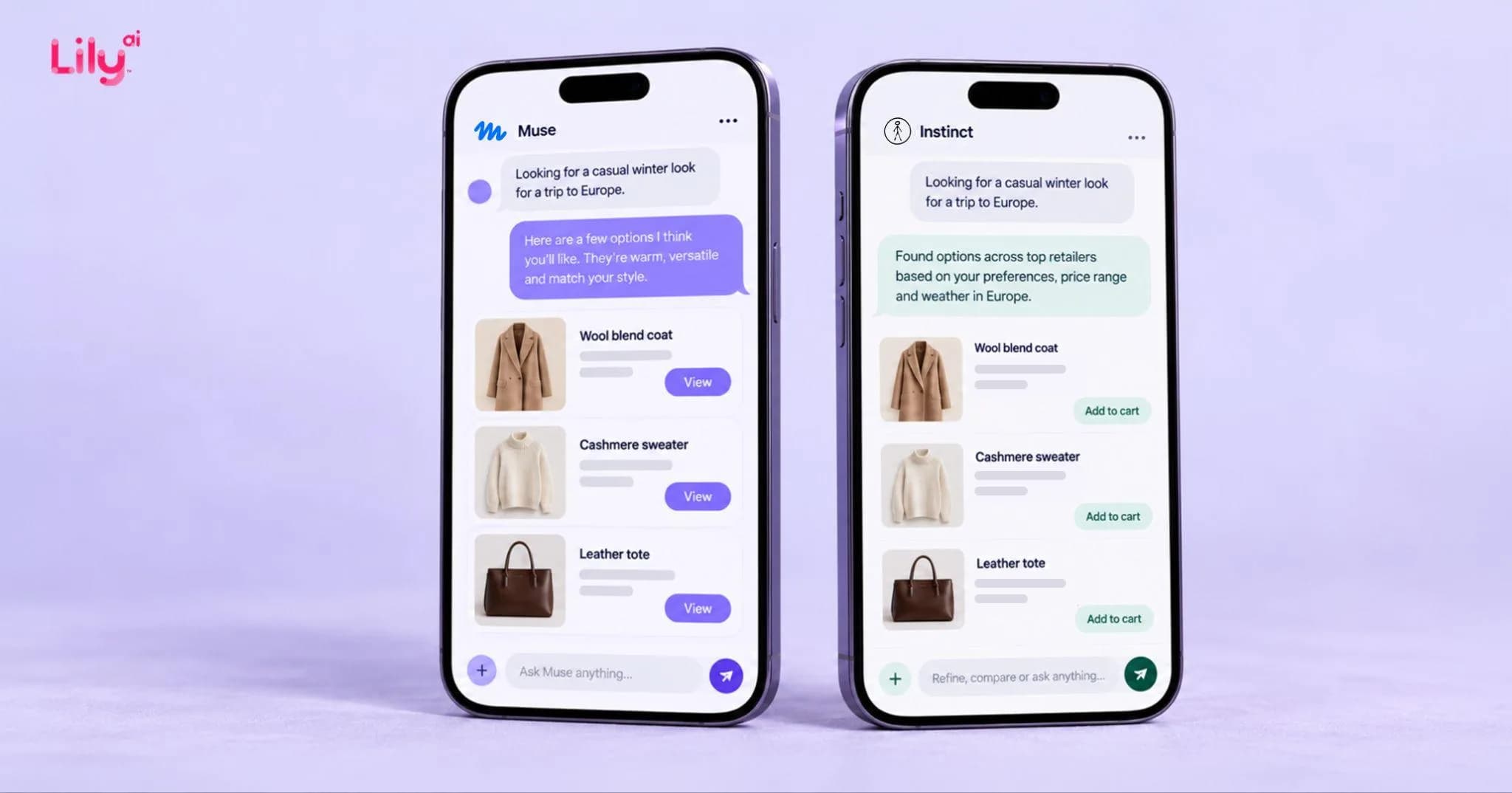
Muse and Instinct are personal AI agents that shop on a person's behalf. Muse is Meta's agent, launched in September 2026 in its own app and WhatsApp. Instinct is a startup's agent reached by text message or WhatsApp. Both can search, compare and buy, so your products now have to make the agent's shortlist before a shopper ever sees them.
Two very different companies launched these agents within weeks of each other, and both focused on shopping first. Below, we compare how each one finds products and checks out, and what that means for your product data.
What is a personal shopping agent?
A personal agent does things on your behalf. A chatbot gives you information and links. A personal agent can remember context about you, use accounts you connect, and finish the job: search, compare, then buy once you say yes.
For shopping, that means the agent reads the product page before the shopper does. The agent takes a request like “a winter coat for my sister, warm but not bulky, under $250”, goes looking, and returns a handful of options. The shopper may never see the rest of the catalog.
Muse vs Instinct at a glance
| Meta Muse | Instinct | |
|---|---|---|
| Made by | Meta | Spear Street Technology, founded by Noah Shinn |
| Launched | 8 September 2026 | August 2026, invite-only |
| Where people use it | The Muse app, WhatsApp and muse.ai | Text message (iMessage or SMS) and WhatsApp |
| Status | Public in the US, with a free tier and paid plans | Private beta |
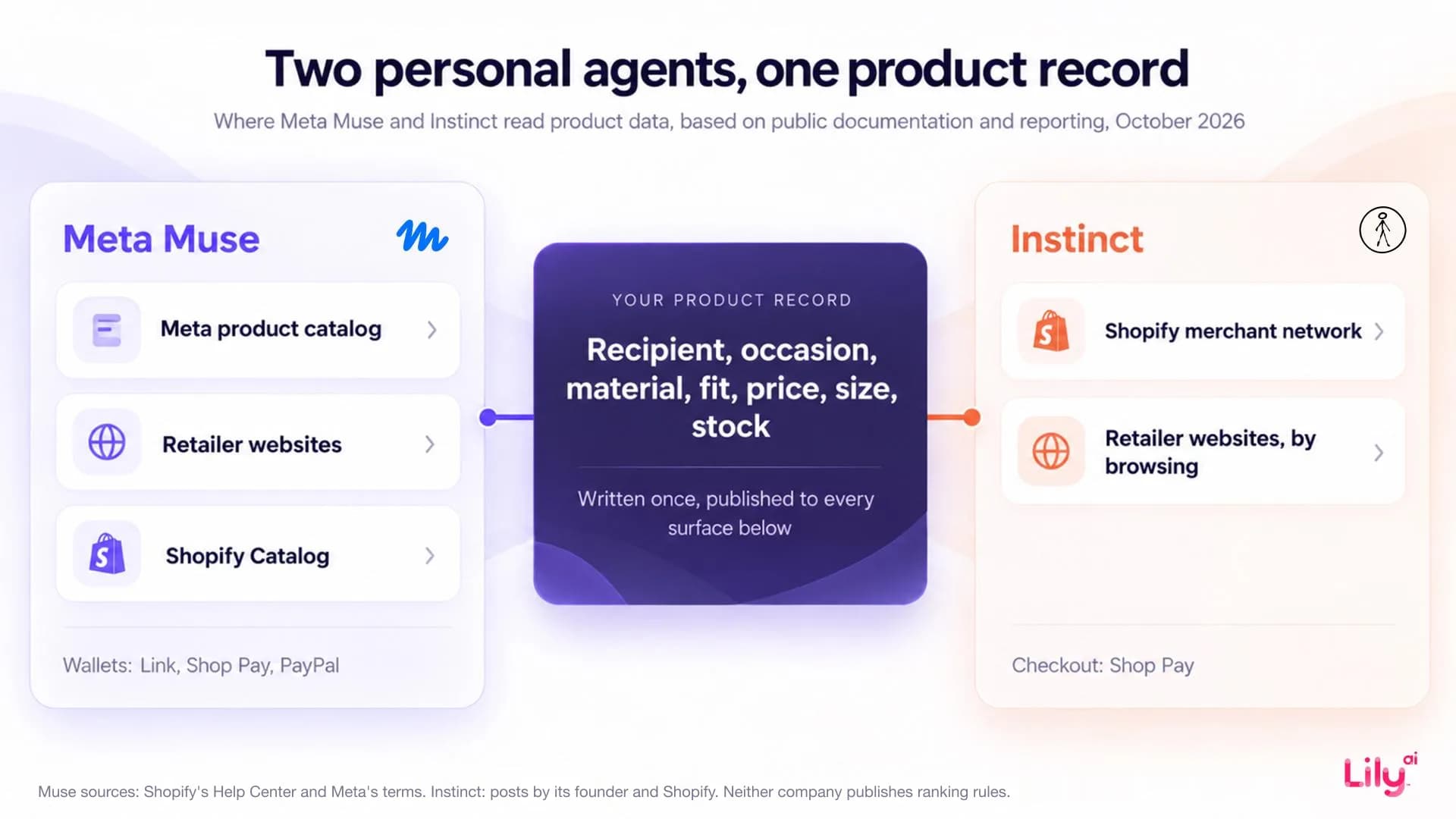
| Where it looks for products | Meta hasn't published its sources. Shopify documents a route through Shopify Catalog, and from 20 November Meta's terms let it crawl the product pages a catalog links to | Its founder describes searching Shopify's merchant network for live price, size and stock |
| How it checks out | Meta's launch post names Link by Stripe. Meta later added Shop Pay, and on 6 October said it was adding PayPal | Shop Pay |
| Scale signals | More than 10 million people in the US and Canada set up Muse in its first month and a half, and shopping is its most common use (Meta, 21 October). Shopping connectors with retailers including Walmart, Best Buy, Sephora and Wayfair, announced at Connect 2026 | A $1 billion Series C at a $10 billion valuation, reported by TechCrunch on 28 September |
Sources: Meta's Muse launch post (8 September 2026), Connect 2026 recap and Q3 2026 earnings call (21 October 2026); TechCrunch reporting on Instinct (24 August, 28 September and 10 October 2026); posts by Instinct's founder and Shopify on X (28 September 2026).
How does Muse find products?
Meta hasn't said which sources Muse reads. Shopify's Help Center documents one route: Shopify merchants' products reach Meta AI and Muse through Shopify Catalog. From 20 November, Meta's revised Commercial Terms also let it crawl the product pages a business's catalog links to. Meta had planned 30 October and moved the date, a spokesperson said on 23 October.
So you need the same product facts in the Meta catalog, in Shopify Catalog and on the product page. Our guide to how Meta Muse finds and picks products breaks this into three stages.
How does Instinct find products?
Instinct's founder describes the shopping flow as searching Shopify's merchant network for live price, size and stock, then preparing the order for Shop Pay checkout. He also lists price-drop alerts, back-in-stock alerts and order updates. Instinct's own site says the agent uses a phone and computer the way people do, which suggests it can also work outside Shopify.
For a Shopify retailer, that means Instinct is shopping straight from your variant, size and inventory data. If a size shows in stock after it has sold out, the shopper ends up with a failed order in their text thread.
Scale is harder to judge. Instinct's founder said on a podcast that the platform is approaching a billion dollars in annual transactions, more than half of them travel. TechCrunch pointed out that he didn't explain how that number was measured, and the company hasn't shared user numbers.
What do the two agents have in common?
The two agents are different, but they need the same four things from a retailer:
| What the agent needs | Why |
|---|---|
| Product facts written in words | Both start from a shopper's request, not a product name, so occasion, recipient, material and fit have to be readable |
| The same facts everywhere | Both can read structured catalog data and live pages, and a mismatch gives the agent two different products |
| Live price, size and stock | Both check what is actually available before they recommend or buy |
| A wallet-ready checkout | Muse uses wallets such as Link, Shop Pay and PayPal. Instinct uses Shop Pay |
It all comes back to the product record. An agent can only recommend what your data lets it understand, which is why the same enrichment work helps with every agent. Our guide to product data enrichment covers how that record gets built at catalog scale.
Where do they differ for retailers?
| Your situation | What matters for Muse | What matters for Instinct |
|---|---|---|
| You sell on Shopify | The Meta channel and Shopify Catalog sharing, which Shopify turned on by default | Shopify's merchant network and Shop Pay, through Instinct's direct partnership |
| You sell on another platform | Your Meta catalog and your product pages | Your product pages, if the agent browses to them |
| You block AI agents | Muse cannot browse your pages. Amazon blocks Muse, Practical Ecommerce reported on 24 September | The same applies to any browsing agent |
| You measure with pixels | Shopify says Google Analytics and custom pixels won't fire in Meta's direct checkout | Orders run through Shop Pay, so check what your reporting sees |
Which other shopping agents should retailers watch?
Muse and Instinct are two of several agents that now take a shopper from request to purchase.
- Google AI Mode and Gemini. Google announced checkout in AI Mode and the Gemini app on 11 January 2026, built on the Universal Commerce Protocol it co-developed with Shopify, Etsy, Wayfair, Target and Walmart.
- ChatGPT. OpenAI scaled back Instant Checkout as a stand-alone feature in March 2026 to focus on discovery, TechCrunch reported, so merchants check out shoppers on their own store.
- Amazon. Alexa for Shopping includes Buy for Me, which can purchase from other retailers' sites for US customers.
- Perplexity. Instant Buy is available to US users, with the order and payment going to the merchant.
Each one reads product data differently, which our explainer on agentic commerce covers in more depth.
What should retailers do now?
- Build one product record with request-ready facts: recipient, occasion, use case, material, fit and season.
- Publish the same facts to every surface an agent reads: the Meta catalog, Shopify Catalog and your product pages.
- Keep live price, size and stock accurate across all of them, especially through holiday promotions.
- Make checkout wallet-ready, and test it as a guest.
- Measure each agent on its own. One agent's results say little about another's.
What we don't know yet
- Neither Meta nor Instinct has published how its agent ranks products.
- Instinct's transaction and usage figures come from its founder and are not audited.
- What is known about Muse's sources comes from Shopify's documentation and Meta's terms, not from Meta describing what Muse reads.
- Both products are changing weekly. Check the facts above against current documentation before acting on them.
How Lily helps
We treat each personal agent as its own channel. Lily Max builds one product intelligence layer with the facts every agent needs, and publishes it wherever each agent reads. Then we measure each agent separately, because results on one don't predict the next.
Book a demo to see how your products read to the agents your shoppers are starting to use.
Frequently asked questions
What is the difference between Meta Muse and Instinct?
Muse is Meta's personal agent, available in its own app, WhatsApp and muse.ai. Meta hasn't published which sources it reads, and Shopify documents a route through Shopify Catalog. Instinct is a startup's agent that people text or message on WhatsApp, and its founder says it shops Shopify's merchant network and checks out with Shop Pay.
Is Instinct made by Meta?
No. Instinct is built by Spear Street Technology, a San Francisco startup founded by Noah Shinn. Meta's agent is Muse.
Can retailers get their products into Muse and Instinct?
There is no public merchant sign-up for either agent yet. For Muse, the documented routes are Meta's product catalog and, for Shopify merchants, Shopify Catalog. Instinct has a direct partnership with Shopify, so Shopify merchants' products are within its reach.
Do I need different product data for each agent?
No. Both agents need the same facts: what the product is, who it is for, what it is made of, how it fits, and whether it is in stock at what price. The difference is where each agent reads them, so publish one accurate record to every surface.

See Lily in action
Book a personalized demo and see how Lily can grow your retail revenue.
Related Blogs
How Meta Muse finds and picks products: a guide for retailers
Meta Muse finds products in three stages. See what it reads, why found is not the same as picked, and what retailers should fix before the holiday rush.
By Lily AI
Meta Muse holiday checklist: 10 fixes before Black Friday
Ten fixes retailers can make before Black Friday so Meta Muse can find, read and recommend their products, from gift facts to checkout and order tracking.
By Lily AI
Agentic commerce: what it is, what changed in 2026, and what a brand actually has to do
Agentic commerce is AI agents buying on a shopper's behalf. What changed in 2026, what an agent reads from your catalog, and what to fix before Q4.
By Lily AI
WebMCP for ecommerce: AI assistants can now shop your store directly
WebMCP lets AI assistants search and shop your store directly, and Shopify and BigCommerce switched it on. What it is, what assistants read, how to check.
By Lily AI
Google Universal Cart turns your price drops into shopper alerts
Google Universal Cart alerts US shoppers when saved items drop in price or restock. What it reads from your listings, and what to check before your freeze.
By Lily AI
How AI Shopping Assistants Actually Pick Which Products to Recommend
AI shopping assistants retrieve before they rank. See what each surface reads from your product record, and which missing attributes disqualify you.
By Lily AI