Why Product Attributes Are Key to Dominating Google Shopping Ads: Part 1
The ways people speak evolve every day
This is due to the inclusion of new trends, slang, and general terms. (Snatched is the new On Fleek, after all!) At the same time, the ways people shop also evolve. Brands and retailers absolutely must keep up with both.
Today, 81% of retail shoppers conduct online research before buying. As all of these people peruse online product listings, a critical component of connecting them to the items they want is the inclusion of customer-centric language in a product’s attributes. These details describe the physical components of an item, the trends it aligns with, the occasions it can be used for, and so on.
Yet enriching and verifying product attributes is often challenging, and why most brands and retailers need help. Yet they are critical, as it can inspire that point of discovery and drive people to complete a purchase. For example, Lily AI customers who inject customer-centric language into their product catalogs see:
+25-36% increases in site traffic +15-25% increases in sales
Here, we look at how to nail product attributes in order to connect with customers via Google Shopping Ads (fka Product Listing Ads or PLAs), specifically. As every $1 spent on Google Shopping Ads drives an estimated $8 return on investment, optimizing Shopping Ads drives the kind of ROI even a CFO can believe in.
Why are customer-centric product attributes critical?
Simply put, the right product attributes speak the language of your customers, helping them discover and purchase your products. This is because these attributes use natural customer language— the terms, phrases, and occasions people are actually searching for. Prioritizing these attributes is an excellent first step in connecting people to products today AND tomorrow.
While it’s never too late to enhance product attributes with the language of the customer, only a retail-focused AI solution can help you implement these updates efficiently and accurately, so they contain the right consumer language.
Lily AI stands out here, as a retail-specific AI solution, due to its inclusive and extensive taxonomy. This contains 25k attributes—aka 25k new opportunities to connect with potential customers—which detail:
Objective Attributes: Including item types, materials Subjective Attributes: Including styles, occasions Attribute Synonyms: Such as “glossy” vs. “high shine” Macro and Micro Trends: Such as Barbiecore, Modern Farmhouse, or Clean Girl International Language: Including localized terms, translations
For example, on the left below you can see what a typical brand or retailer’s product attributes look like before Lily AI. After being enriched by Lily AI to include the latest micro-trends, special occasions, styles, and more, the product’s attributes are now far more detailed and more inclusive of the natural consumer language, leading to higher-performing search results.
Including all of this detailed information within a product listing makes that product more discoverable to shoppers . . . no matter where or how they’re shopping. Customer-centric product attributes lead people to products through a variety of means, from Google Search to Site Search.
How to enhance Shopping Ads
There are a few cards retailers and brands can play, in order to win at both short and long-term strategies for approaching product listings. The most effective way to maximize these results is to use AI to inject product details and attributes that reflect evolving customer language throughout your digital catalog.
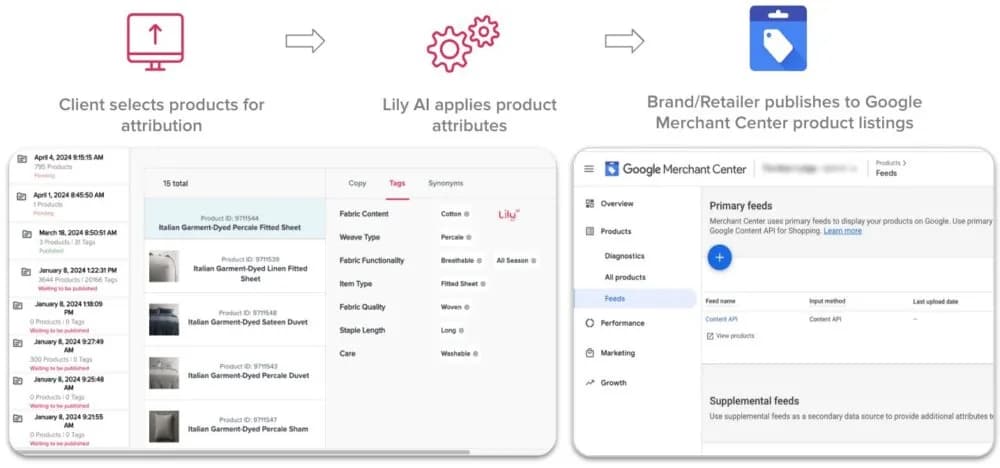
Here’s a preview of Lily AI’s new, direct integration into Google Merchant Center (GMC integration shown below). This direct integration makes it easier than ever for brands and retailers to enrich their product listing ads with these high-performance attributes.
You can learn more about how to approach AI-powered product attribution to connect with potential customers across the following resources:
Our Product Attributes 101 guide
The Ultimate Guide to Integrating Product Attributes, From Google Search to PIM
When Is the Right Time to Transform Your Product Attributes?
Are there other long-term benefits?
No matter where people are searching for products online, retailers need to put the customer at the center of their experiences. There is no easier, more effective way to do this than to include customer language directly in your product attributes.
In part 2 of our series, we’ll show you how consumer shopping habits are changing and how search and shopping are evolving on Google and beyond.

See Lily in action
Book a personalized demo and see how Lily can grow your retail revenue.
Related Blogs
How Lily Max checks AI-generated product descriptions at catalog scale so nothing goes missing
AI-generated product descriptions lose facts before they invent them. How Lily Max splits writing, contracting and checking, then scores records in five different ways.
By Lily AI
How a Lily Max product feed A/B test can be set up in an afternoon
A product feed A/B test proves lift only if the split is balanced, the copies are in sync and the bidder is read on its own. How Lily Max sets one up fast.
By Lily AI
One record, four readers: product information syndication for Google, Meta, onsite search and AI assistants
Product information syndication breaks when four tools keep four copies. How Lily Max derives one record per product and renders it for Google, Meta and AI.
By Lily AI
Lily AI Launches Product Content Optimization for SEO, AEO & GEO
Lily AI has launched a new solution built for the realities of SEO and GEO in 2025, automatically enriching, standardizing, and optimizing product content across ecommerce websites.
By Purva Gupta
Lily AI’s Winter 2025 Release Is Here
Lily AI’s Winter 2025 release brings a suite of advanced features that transform how retailers optimize product catalogs for discoverability and conversion across every channel.
By Lily AI
Lily AI Unveils Its No-Code Product Attributes Platform
The next generation of the Lily AI product attribute platform is now available. With the Lily app, retailers and brands get end-to-end control over attribute management and workflows.
By Lily AI