How to Connect Shoppers to What They Want and Need with Customer-Centric Product Recommendations

Connect Shoppers to What They Want and Need
Without a doubt, the right and relevant product recommendations are evergreen. Connecting shoppers to what they actually want and need this month, and every month after, is always worth the extra effort. This is especially true when you consider that research shows shoppers have an increasingly strong point of view on being provided relevant product recommendations.
In fact, according to a study conducted in 2021, 81% of shoppers reported not finding any recommendations on the product listing pages (search results or category pages) of e-commerce sites. However, let’s consider these facts:
- 37% of shoppers that clicked a recommendation during their first visit returned.
- Purchases, where a recommendation was clicked, saw a 10% higher Average Order Value (AOV).
- Shoppers that clicked on recommendations are 4.5x more likely to add items to cart and complete their purchase.
- Relevant product recommendations are estimated to account for more than 35% of purchases on Amazon.
- 49% of consumers said they have purchased a product that they did not initially intend to buy after receiving a relevant recommendation.
- 75% of customers are more likely to buy based on recommendations.
With the right product recommendation capabilities by your side, you can supercharge your existing e-commerce stack – helping each consumer to find what they want with more ease and less frustration.
Connect Shoppers to What They Want and Need This “Wear a Dress Day”
“Wear a Dress Day” is celebrated every year by giving women the opportunity to sport their favorite dress for the day. This includes a wide variety of dresses with many different designs, patterns, and more – a truly rich taxonomy of attributes.
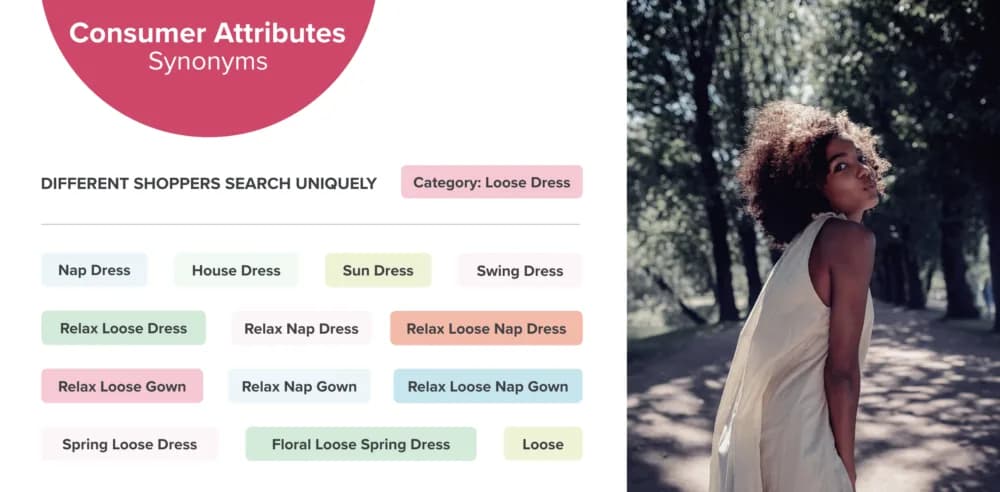
Help your shoppers dress to impress this “Wear a Dress Day” by building a rich customer-centered product taxonomythat describes products in the language that shoppers actually use. Different shoppers are going to search for items in their own unique way, making it essential to capture both common and long-tail terminology for better search diversity.
For instance, under the category of “loose dress” lies a number of synonyms that also match, including “sun dress,” “nap dress,” and more.
Connect Shoppers to What They Want and Need Every Day
Today’s e-commerce stack is overflowing with bad guesses about shoppers and the products they actually want to be recommended, leading to low conversion rates, high return rates, and a high number of unsold inventory. Customers want a shopping experience that shows that you know and understand who they are as a person in the same way a skilled staffer in a brick-and-mortar store would.
This requires an understanding of not just purchasing patterns and basic demographics — but an understanding of why they purchase what they purchase, which is an entirely different challenge. This is where AI comes in. Shoppers don’t just want recommendations based on colors or sizes. Relevant product recommendations must reflect customers’ genuine preferences and affinities. At the end of the day, they want to feel like you “get them.”
Connect Shoppers to Next-Level Customer-Centric Product Recommendations
Lily AI can elevate your existing site from its current level to “next-level” in just a few weeks through our proprietary machine-learning algorithms. It’s a two-stage process: first our technology analyzes your products and identifies the wealth of crucial data you’re currently leaving untapped, then we leverage that data to build more relevant product recommendations, strengthening the online shopping experience on a granular level.
Most sites’ product taxonomy is limited and currently uses only a few searchable tags to identify and quantify products – not to mention applying tags takes time, costs money, and needs to happen with every seasonal change in your inventory. Our software identifies all of the details that matter — up to dozens per garment — creating a dataset that’s richer by several orders of magnitude. Lily AI, as a product attributes platform, also strongly focuses on customer-centric product recommendations.
When products are attributed with generic, legacy, or industry-focused language, as opposed to customer-centric product attributes that speak in the language of the consumer, these products are far less likely to reach their potential to sell at full-margin. Legacy, generic attributes are those which can be classified as “out-of-the-box” and are provided directly by the merchant, distributor, or manually attributed by the end merchandiser themselves. But to create a shopping experience that converts, retailers must dive a bit deeper to understand how to plan their assortment accordingly and move past generic attributes.
AI-powered, customer-centric product attributes are a key and important part of building a taxonomy that converts and creates a strong and relevant product recommendation process that gets products on the site at the right time and does what you want them to – sell at full price. Being able to offer the exact product a customer is looking for, exactly when they want it (whether they know they want it or not), is the ultimate goal of relevant product recommendations.

See Lily in action
Book a personalized demo and see how Lily can grow your retail revenue.
Related Blogs
Lily AI Launches Product Content Optimization for SEO, AEO & GEO
Lily AI has launched a new solution built for the realities of SEO and GEO in 2025, automatically enriching, standardizing, and optimizing product content across ecommerce websites.
By Purva Gupta
Lily AI’s Winter 2025 Release Is Here
Lily AI’s Winter 2025 release brings a suite of advanced features that transform how retailers optimize product catalogs for discoverability and conversion across every channel.
By Lily AI
Lily AI Unveils Its No-Code Product Attributes Platform
The next generation of the Lily AI product attribute platform is now available. With the Lily app, retailers and brands get end-to-end control over attribute management and workflows.
By Lily AI
Start Harnessing Natural Language Search to Optimize Google Ad Performance
Google Shopping Ads are perhaps a retail marketer's most powerful weapon, and optimizing them with AI makes ads even more powerful. Here's how to operationalize natural consumer language.
By Lily AI
Partner Spotlight: Algolia
Algolia is the leader in search, and horizontal AI search solutions like Algolia work best when integrated with vertical AI search solutions like Lily AI. It's 1+1=5.
By Lily AI
Why Product Attributes Are Key to Dominating Google Shopping Ads: Part 1
The ways people speak and shop evolve every day, and brands must keep up. How to nail customer-centric product attributes to connect with shoppers via Google Shopping Ads.
By Lily AI