Effective Product Attribution Q&A with Lily AI’s Sean Gouldson

Granular product attributes can make all the difference for retailers and brands when their products are attributed comprehensively in the language of the consumer, as opposed to falling back on legacy, generic out-of-the-box attributes.
But how exactly does this process of attributing products more effectively work in order to drive bigger cart sizes, stronger conversation rates, and more? We sat down and talked with Sean Gouldson, Lily AI’s Head of Presales, to discuss some of the top questions retailers and brands want to know about the ins and outs of product attribution data.
How is product attribution applied? What are the nuts and bolts of how this works? What does the item set-up with Lily AI data look like?
When it comes to a retailer’s process for onboarding a new product and getting it ready to sell digitally or online, there is a lot more to it than meets the eye. There’s so much that comes into play with this. For instance, how a retailer may index for search, what page the new product is going to show up on, how filters and facets will be deployed for navigation, and more. Product attribution data can help to tackle all of these behind-the-scenes internal processes with an optimized item set-up or better onboarding practices.
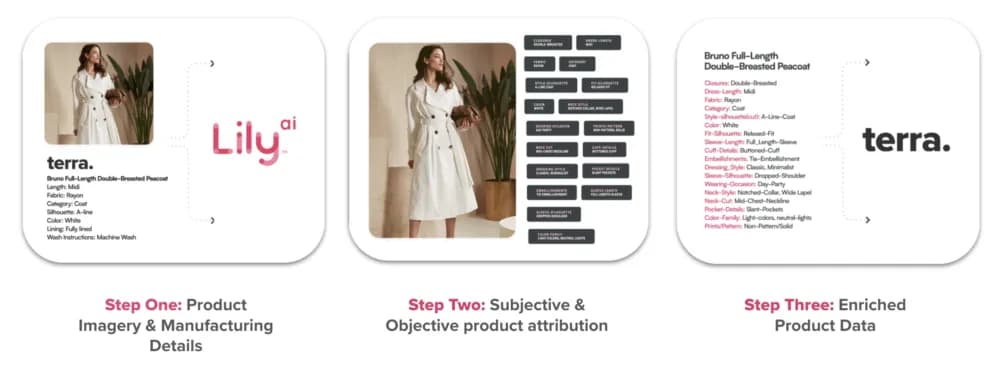
So, what does this look like with Lily AI’s help? Lily AI works to take the retailer’s current data to either improve or replace some of the existing processes or workflows. For example, a retailer is already going to have assets present – they’re going to have an image and text – but this still may not be enough to offer something for sale online.
The next steps include passing this present data (the images and text) to Lily AI in batches where we will give the retailer the most accurate and relevant product attributes back.
Lily AI takes the data feed and breaks it into batches of similar products. After this, we will:
- Run the data through two different AI-powered processes: Image recognition AI-based classification
- Run the text through text recognition and Natural Language Processing (NLP) pipelines.
- Combine and leverage the image and text together (image and text based predictions together get better results than separately).
- Loop in the human element of our domain experts team who may review a selection of the data for better accuracy.
Does the foundational product data coming from a retailer or brand need to already be strong to gain the benefits of Lily AI enrichment and enhancement?
The foundational product data coming from a retailer or brand doesn’t already need to be strong in order to gain the benefits of Lily AI’s enrichment and enhancement capabilities. As long as you have images and basic text that could be used for non-visible details (i.e., materials, lining, etc.) your product data is viable, and Lily AI can take that as the input.
Does Lily AI pull all of the product attributes from historic images? What does a retailer or brand need to provide Lily AI?
Lily AI pulls as many attributes as we can from the images and text that is provided for us. Historical products refer to products that aren’t new, but are currently on sale. The images we pull product attributes from do not have to be historic. We like to keep it simple and as long as we have those images and text we can combine them, improve upon them, and send the retailer back a single set of data.
Do subjective tags change over time (based on season, for instance)?
Generally the tags don’t change over time, because the merchandise is still the same. Although the merchandise may be intended for a specific season or occasion, the only way Lily AI would alter the tags is by offering additional ways to describe the merchandise as we see trends change. The way a consumer may describe products with their own language and their own concepts may change, so Lily AI may add things over time to keep the tags rich with that updated relevant data.
The additional ways to describe merchandise due to seasons or emerging trends may very much evolve, therefore Lily AI can add things to keep the tags as fluid as possible.
Do Lily AI teams review tags to ensure consistency with the brand, or is it all automated?
This depends on the customer and their own specific needs. Lily AI will work to find the right approach, while our teams of experts can review the automation and its results as necessary.
Can the AI read lifestyle images, or just product imagery?

Lily AI can do both! We can read lifestyle, multi-product images, high quality catalog photography with photos of apparel (e.g., mannequins, hangers, flatlays), and/or photos of clothing models.

See Lily in action
Book a personalized demo and see how Lily can grow your retail revenue.
Related Blogs
Lily AI Launches Product Content Optimization for SEO, AEO & GEO
Lily AI has launched a new solution built for the realities of SEO and GEO in 2025, automatically enriching, standardizing, and optimizing product content across ecommerce websites.
By Purva Gupta
Lily AI’s Winter 2025 Release Is Here
Lily AI’s Winter 2025 release brings a suite of advanced features that transform how retailers optimize product catalogs for discoverability and conversion across every channel.
By Lily AI
Lily AI Unveils Its No-Code Product Attributes Platform
The next generation of the Lily AI product attribute platform is now available. With the Lily app, retailers and brands get end-to-end control over attribute management and workflows.
By Lily AI
Start Harnessing Natural Language Search to Optimize Google Ad Performance
Google Shopping Ads are perhaps a retail marketer's most powerful weapon, and optimizing them with AI makes ads even more powerful. Here's how to operationalize natural consumer language.
By Lily AI
Partner Spotlight: Algolia
Algolia is the leader in search, and horizontal AI search solutions like Algolia work best when integrated with vertical AI search solutions like Lily AI. It's 1+1=5.
By Lily AI
Why Product Attributes Are Key to Dominating Google Shopping Ads: Part 1
The ways people speak and shop evolve every day, and brands must keep up. How to nail customer-centric product attributes to connect with shoppers via Google Shopping Ads.
By Lily AI