Stripe is building the rails. Your product data decides who wins on them.
Part of: AI discovery and agentic commerce
View on LinkedIn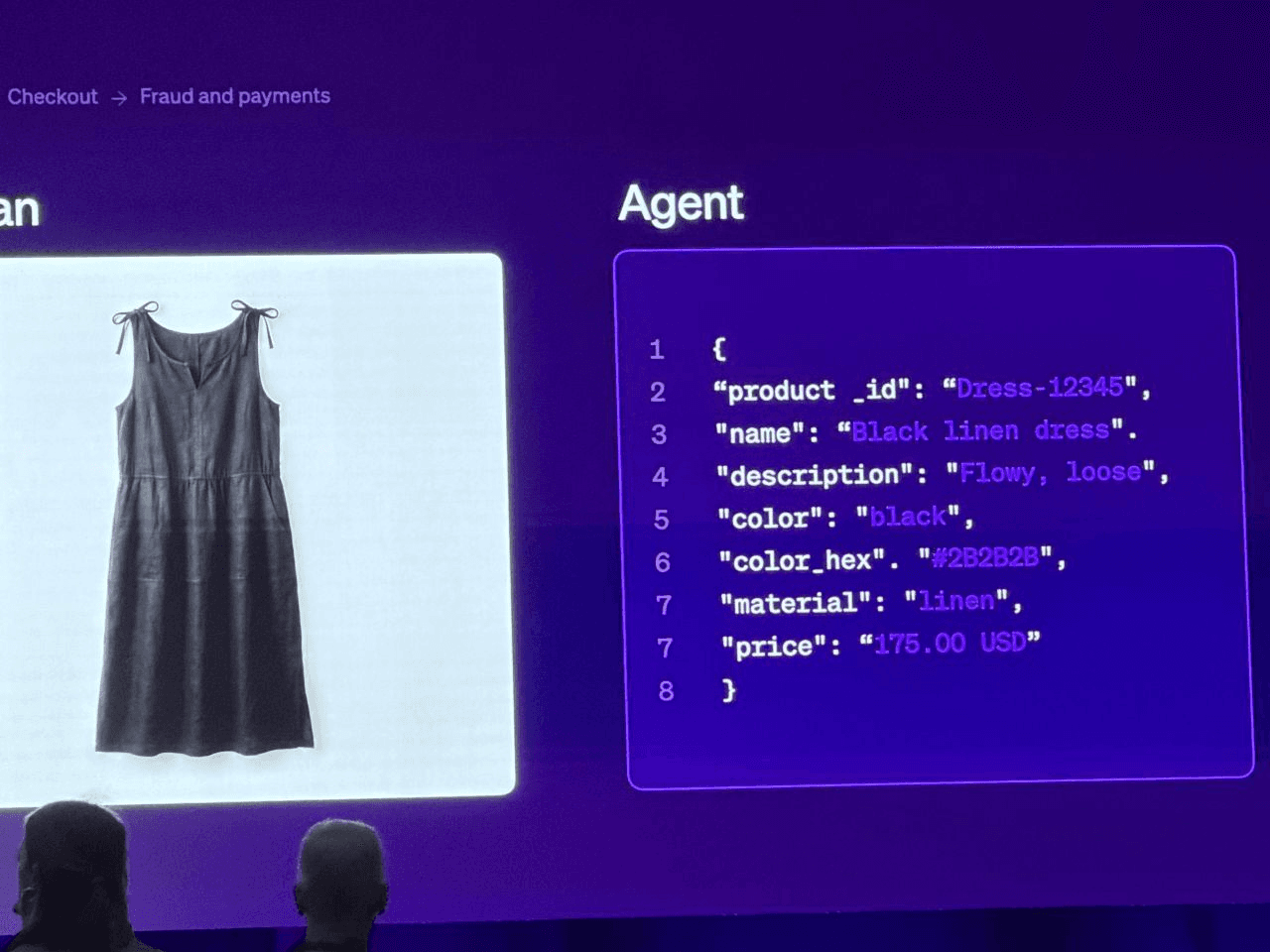
I spent a day at Stripe Sessions in San Francisco. This was one of the busiest conferences I've ever attended.
Always a treat to hear Sam Altman in conversation with Patrick Collison. You get the clearest signal on where AI is actually heading.
This time, the signal was unmistakable. Agentic commerce has moved from “interesting future” to “build now.”
Here's what stood out:
- Stripe announced 288 new products and features. The scale of what they're working on to build economic infrastructure for AI is staggering.
- They sized the B2C agentic commerce opportunity at $5T by 2030 and named the brands already moving: Etsy, Coach, Kate Spade, Quince, Fanatics, Best Buy, Halara, Ashley, JD Sports, Wix, BigCommerce.
- They introduced a five-level framework for agentic commerce maturity: no more forms, descriptive search, persistent memory, delegating decisions, invisible anticipation.
- The Agentic Commerce Suite expanded with partnerships on Google's UCP and Meta's native ad checkout, plus Link's new agent wallet and Shared Payment Tokens, the primitive that lets agents securely pass payment credentials between buyer and seller.
But one slide stopped me.
It had a product image of a black linen dress on the left. On the right, the JSON object the agent sees, with seven fields: product_id, name, description, color, color_hex, material, price. That's what the agent has to work with.
Now think about how a real shopper actually asks her agent to find this dress.
- “Find me a sleeveless midi dress for a summer wedding”: length and occasion aren't in the feed.
- “Something with tie-shoulder details, A-line, V-neckline”: the actual design isn't there.
- “A vacation dress under $200, machine washable”: no use case or care instructions.
- “Unlined linen, quiet luxury, true to size”: no lining, aesthetic, or fit guidance.
- “A black dress that pairs with tan sandals and gold jewelry”: no compatible accessories, no styling.
The agent can't answer any of these. Not because the dress doesn't have these qualities, but because none of it is structured into the data the agent reads.
This is the entire thesis behind what we're building at Lily AI.
When the buyer is an agent, your product page is no longer the unit of commerce. Your structured product data is. Length, silhouette, neckline, closure, occasion, care, fabric weight, lining, aesthetic, compatible accessories. Every one is a typed field an agent can rank, filter, and transact against. Or it isn't, and you're invisible.
The discovery surface keeps shifting. Search, social, marketplaces, and now agents. The product intelligence layer compounds under it.
Stripe is building the payment rails for agentic commerce. The brands that win on those rails will already have their product data ready.
It was great catching up with Tanvi Narain of Counterpart Ventures and Mandeep Bhatia of Tapestry. Thanks, Mandeep, genuinely lucky to have partners thinking this far ahead about where commerce is headed.


See Lily in action
Book a personalized demo and see how Lily can grow your retail revenue.
Related Blogs
Agentic commerce: what it is, what changed in 2026, and what a brand actually has to do
Agentic commerce is AI agents buying on a shopper's behalf. What changed in 2026, what an agent reads from your catalog, and what to fix before Q4.
By Lily AI
How AI Shopping Assistants Actually Pick Which Products to Recommend
AI shopping assistants retrieve before they rank. See what each surface reads from your product record, and which missing attributes disqualify you.
By Lily AI
The Role of Product Content in AI Search and Discovery
Product discovery is experiencing its biggest shift since digital commerce began. This report gives retailers a framework for structuring product content so generative engines can surface it.
By Lily AI
The Readiness Gap: Why 70% of Shoppers Are Ahead of Retailers in AI Commerce
Shoppers are adopting AI-powered shopping faster than retailers can adapt. This report reveals how consumers use AI to search, compare, and buy, and what brands must do to stay visible.
By Lily AI
Product Discovery Disrupted: From SEO to GEO and Beyond
See why AI disrupted search and shopping for the better, and how to succeed in the new world of AI-powered search and shopping across paid, organic, and owned on-site.
By Lily AI
The Search for Smarter Shopping: The Power of Product Content
Findings from a consumer shopping survey conducted by Lily AI in January 2025, on the heels of the 2024 holiday season, assessing consumer sentiment toward online search and discovery.
By Lily AI