The most expensive thing in retail right now
Part of: Proof: controlled tests and case studies
View on LinkedIn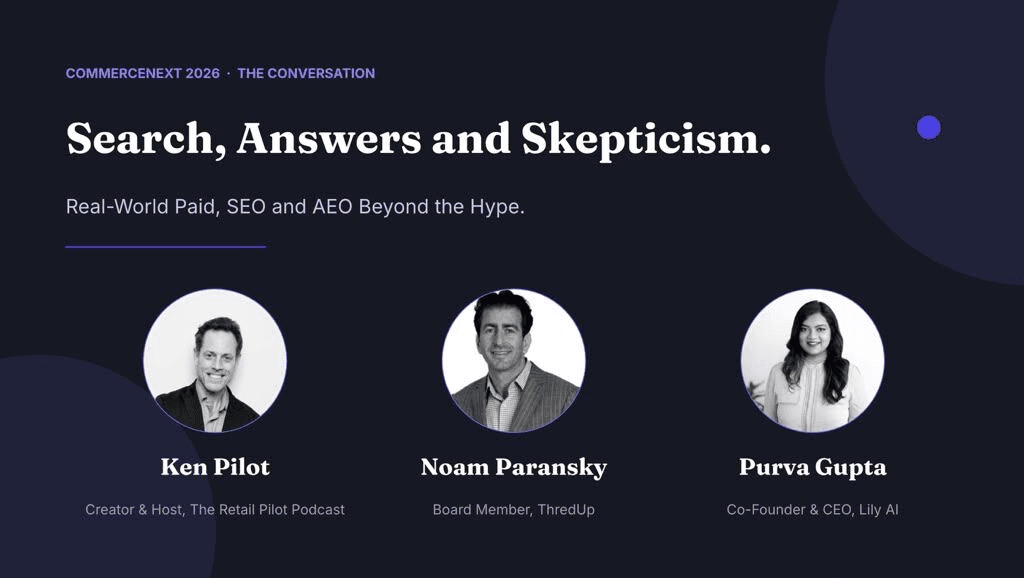
The most expensive thing in retail right now is the attention brands are pouring into a future that isn't generating revenue yet.
Every brand I talk to is being pulled into the same script.
Optimize for AI answers, get ready for agents, prepare for a web where machines do the reading. Most of the discovery shift is real, but very little of it is moving a dollar this quarter, and almost none of it comes with a way to prove that it did.
Meanwhile the surfaces actually producing revenue today get treated like settled infrastructure that doesn't need attention anymore.
Teams fund the speculative thing and starve the working thing, because the speculative thing is where the conversation is loudest.
This is the conversation I want to have in the open.
At CommerceNext, I'm joining Ken Pilot and Noam Paransky for a session called “Search, Answers and Skepticism.” Ken has built some of the most recognizable brands in retail. Noam has driven over a billion dollars of online growth. Different seats, same low tolerance for a story that cannot be measured.
We'll get into what is genuinely shifting across paid search, AI Overviews, and answer engines, where brand still wins when a machine is choosing, and the question most people skip: how would you even know any of it is working?

See Lily in action
Book a personalized demo and see how Lily can grow your retail revenue.
Related Blogs
A buying standard for AI commerce
Four questions to ask before you fund any AI marketing tool. Every retail budget now carries an AI line item, and almost nothing on it arrives with a way to know whether it worked. Here's the standard, and the one shortcut to remember it: would it survive a finance review?
By Purva Gupta
Does feed optimization increase sales? The anatomy of a controlled test
Does feed optimization increase sales? Yes, against a control. Get the full test design: matched spend, 28-day holdout, difference-in-differences.
By Lily AI
You don't have an agency problem. You have an input problem.
A CMO fired three paid agencies in two years and decided you can't find a good one anymore. The real problem was upstream: the old agency edge has been commoditized, and the leverage has moved to the inputs only the brand controls.
By Purva Gupta
Google says conversational attributes are optional. History says otherwise.
Mobile-friendly, page speed, structured data: Google introduced each as optional, and each became the price of entry. Conversational attributes, its new AI-shopping feed fields, look like the next one.
By Purva Gupta
It always turns out to be a feed
OpenAI spent a year pitching conversational shopping, then quietly rebuilt something that looks a lot like Google Merchant Center. Every platform that monetizes shopping ends up needing the same thing first: a feed.
By Purva Gupta
Google may have just created a billion-dollar optimization market
AI visibility struggled to attract serious budget for a simple reason: nobody funds what they can't measure. With Google's new AI Performance Insights, it's measurable now. So the money moves.
By Purva Gupta