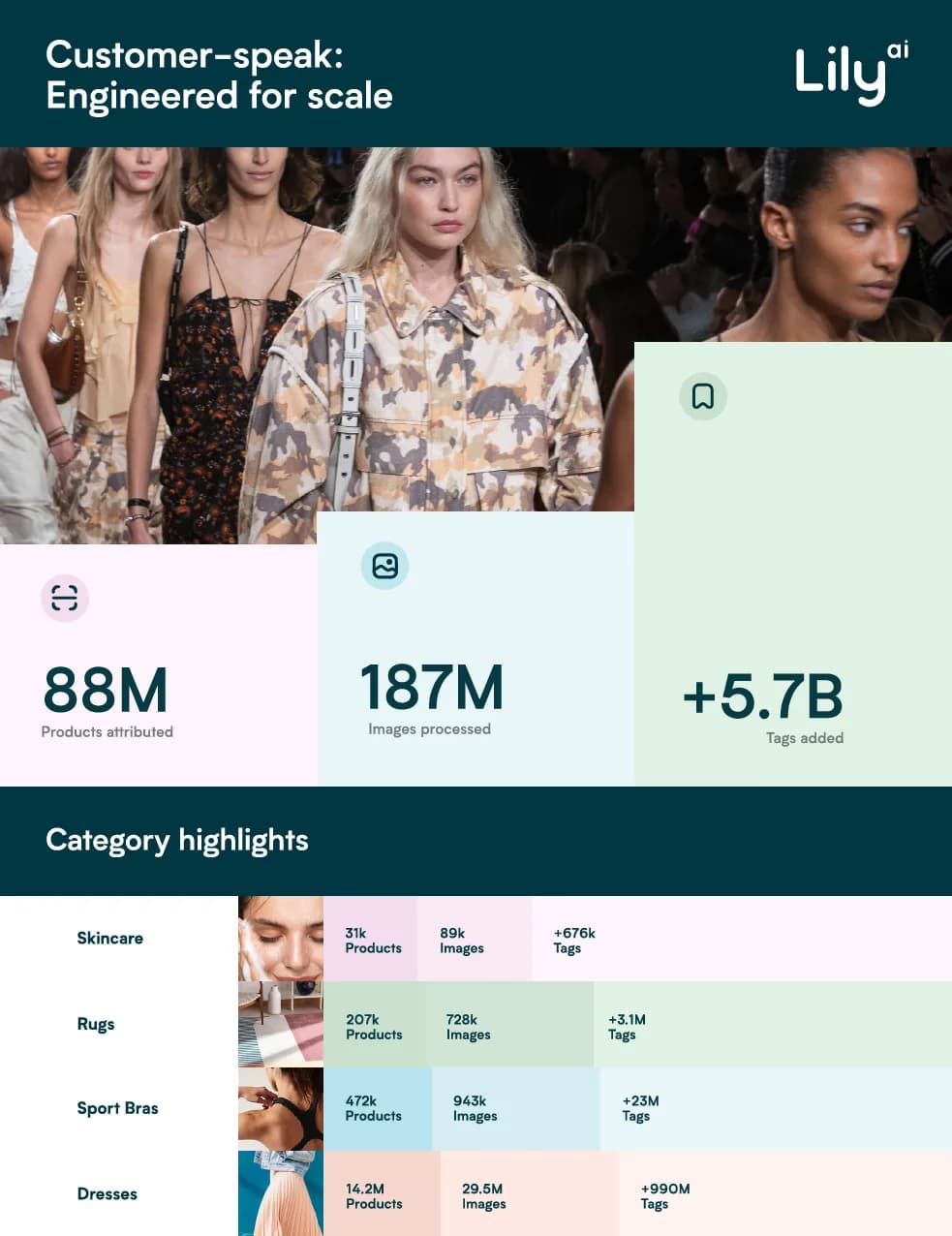
This week, The New York Times published a feature highlighting Lily AI’s impact on retail. We often get asked to demystify our AI and quantify our current scale, which of course, we are happy to do! The infographic below reflects recent volumes and examples of products we’ve enhanced to-date, yet before we dive in, let’s start with the basics.
It all starts with understanding “consumer-speak.” This includes colloquial search terms, attributes, occasions, trends, and synonyms; essentially, a diverse array of conversational language that real people–not merchandisers or fashion insiders–use when they talk and shop. In retail, these terms translate to “product tags,” the product descriptors which are the foundational elements of what makes a product unique.
Over the past 8 years, Lily AI has developed a product taxonomy–an industry-specific language library– of 20,000 words used by consumers to describe fashion, home, and beauty products. Lily AI then integrates this product taxonomy with AI, specifically computer vision, natural language processing, machine learning, and vertical-specific large language models. This powerful combination enables Lily AI to process millions of product images and text, and automatically generate the most comprehensive and accurate set of tags for every product.
From dresses and bras to rugs and skincare, and everything in between, Lily AI helps retailers better understand what consumers want and helps shoppers find exactly what they need.

See Lily in action
Book a personalized demo and see how Lily can grow your retail revenue.
Related Blogs
Details Matter: How Product Discovery In the Age of AI and GEO is Evolving for Home Decor Retailers
Finding home decor online shouldn’t feel like a chore. A survey of 2,081 U.S. consumers reveals what today’s buyers want and how the right details get a product found first, then sold.
By Lily AI
The Search for Smarter Shopping Continues: New Consumer Shopping Research Unveils Product Content Gaps
After the 2024 holiday season, Lily AI surveyed over 2,000 U.S. shoppers to answer one question: has AI made shopping better? Here are the highlights, plus the full infographic.
By Lily AI
How Lily Max checks AI-generated product descriptions at catalog scale so nothing goes missing
AI-generated product descriptions lose facts before they invent them. How Lily Max splits writing, contracting and checking, then scores records in five different ways.
By Lily AI
How a Lily Max product feed A/B test can be set up in an afternoon
A product feed A/B test proves lift only if the split is balanced, the copies are in sync and the bidder is read on its own. How Lily Max sets one up fast.
By Lily AI
One record, four readers: product information syndication for Google, Meta, onsite search and AI assistants
Product information syndication breaks when four tools keep four copies. How Lily Max derives one record per product and renders it for Google, Meta and AI.
By Lily AI
Agentic commerce: what it is, what changed in 2026, and what a brand actually has to do
Agentic commerce is AI agents buying on a shopper's behalf. What changed in 2026, what an agent reads from your catalog, and what to fix before Q4.
By Lily AI