From Experimentation to Expectation: How AI Shopping Normalized Faster Than Retail Prepared
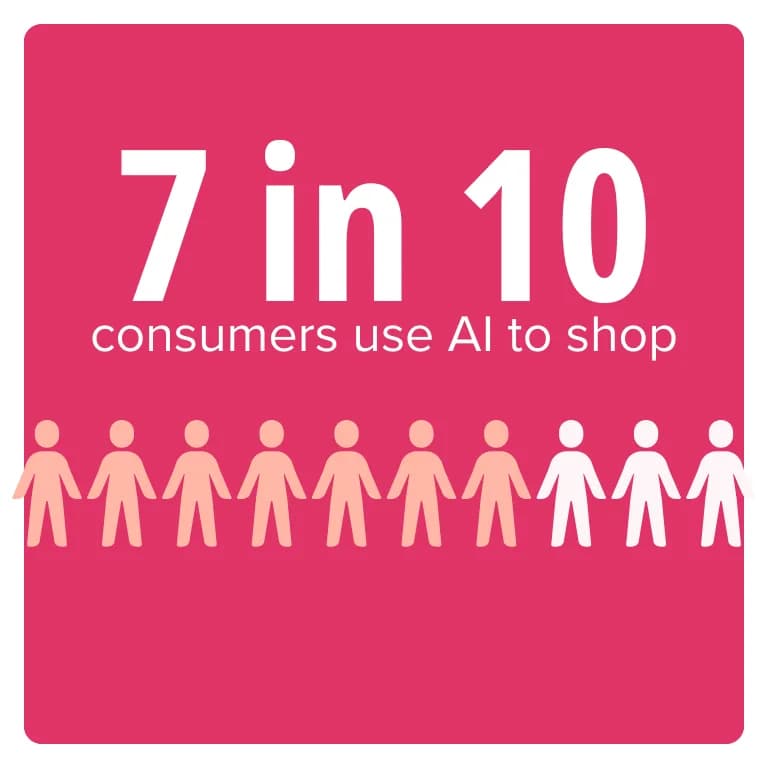
Over the course of 2025, AI-powered shopping moved from cautious experimentation to everyday utility. Comparing Lily AI’s shopper surveys fromearly andlate 2025 reveals not just rising adoption, but a deeper shift in how consumers search, discover, and decide what to buy.
Three changes stand out: AI usage surged, patience with traditional search eroded further, and the places where shopping began continued to fragment. Together, they signal a fundamental change in discovery, one increasingly mediated by AI systems that depend on product understanding and consumer context, not keywords.
Why AI Shopping Accelerated So Quickly
The behavioral shifts we observed align closely with how AI platforms rolled out shopping capabilities over the year. Early on, AI tools focused on research and comparison. As 2025 progressed, the various generative AI platforms started to move steadily closer to transaction.
In the first half of the year, OpenAI expanded ChatGPT’s role in shopping by enabling product discovery and comparison, followed by Instant Checkout, positioning AI as more than a research assistant. By midyear, Google began reframing search through Gemini-powered AI Mode, shifting discovery toward conversational answers and recommendations. By late 2025 and into early 2026, announcements at CES and NRF, from Google’s Universal Commerce Protocol and Business Agents to Microsoft’s Copilot Checkout and brand-controlled shopping agents, made end-to-end, AI-assisted shopping explicit.
Seen in sequence, these moves help explain why AI adoption in our survey data accelerated so quickly. As AI systems became better at understanding products, reducing effort, and supporting purchase decisions, shoppers began using them not just to explore but to start and advance their shopping journeys.
AI Usage Reached a Tipping Point
Early in 2025, most shoppers were still on the sidelines. Roughly 60% had never used AI for shopping, and fewer than 3% considered themselves active users.
By late 2025, that picture had changed materially: 54% of shoppers had used AI for shopping-related purposes.
Comfort Held Steady as the Stakes Increased
At first glance, openness to AI appears stable:
- Early 2025: 70.7% were open to using AI at some stage of the shopping journey
- Late 2025: ~68% were open to buying directly through AI platforms
But the questions themselves changed. Early in the year, shoppers were reacting to the idea of trying AI search. Later in the year, they were reacting to the idea of purchasing through AI.
Holding roughly the same level of openness while asking for a higher-risk behavior signals normalization, moving AI closer to the point of purchase.
Resistance to AI Is Rapidly Shrinking
One of the most telling shifts is how quickly outright resistance collapsed:
- Early 2025: 29.18% said they would never use AI shopping tools
- Late 2025: only 10.5% said they would never buy through AI
Even when framed around a larger commitment, the “absolutely not” segment dropped by nearly two-thirds. Consumer resistance to AI shopping is softening faster than many retailers expected.
Search Fatigue Is Getting Worse… Faster
While AI adoption rose, tolerance for traditional search continued to erode.
- Gave up on an online search entirely Early 2025: 79.63% Late 2025: 84.11%
- Quit after just 1–3 searches Early 2025: 17.92% Late 2025: 27.29%
Shoppers are abandoning sooner, trying fewer variations, and showing less willingness to “work” for relevance. Expectations are rising, and patience is shrinking.
Where Shopping Starts Is Shifting
The front door to shopping continues to change. Traditional search slipped slightly as a primary starting point, while new channels gained ground. By late 2025, nearly 10% of shoppers reported starting their journey on an AI search platform, putting AI ahead of many retailer sites as a first touch.
Discovery is no longer linear. Now, it’s distributed across systems designed to summarize, compare, and recommend before a shopper ever reaches a product page.
What Shoppers Actually Want From AI
Despite rapid adoption, shoppers are not looking to hand over total control. At this stage, their expectations are practical:
- Compare prices
- Match taste or style
- Compare options
- Summarize reviews
Looking ahead, most envision a hybrid future where AI does the initial heavy lifting, but humans review the information presented to them and ultimately make their final decision. AI’s perceived value lies in clarity, speed, ease and effort reduction, not necessarily full automation of each and every step in any given shopping journey.
What This Means for Retailers
Between early and late 2025, AI shifted from an experimental layer to a default part of product discovery faster than most retail systems and processes were built to support. As shopping discovery moves upstream into AI-assisted interfaces, visibility is no longer driven by keywords alone. Instead, visibility is driven by whether products can be clearly interpreted, compared, and confidently recommended by machines acting on shoppers’ behalf. In this environment, discovery performance is increasingly determined by the quality, richness and structure of product content that feeds every discovery and shopping surface—search, marketplaces, ads, and AI-driven experiences.
In an AI-mediated shopping journey, product understanding is the prerequisite for discovery, recommendation, and ultimately, purchase. But that understanding doesn’t happen automatically. It has to be built.
This is where many retailers and brands now face a gap. Their product data was created for human browsing and keyword-based search, and not for intelligent systems that need to interpret intent, compare options, and clearly explain tradeoffs in natural language. As AI becomes the front door to shopping, incomplete, inconsistent, or generic product content will result in underperforming products, if not rendering them completely invisible altogether.
At Lily AI, we see this shift playing out daily with our customers. The brands that are pulling ahead are proactively investing in product intelligence that can travel across every AI interface. By continuously ingesting product data, enriching it with real shopper language, optimizing it for each discovery surface, and learning from performance signals, Lily helps brands ensure their products are understandable, comparable, and recommendable wherever shopping begins whether that’s search, ads, marketplaces, or AI assistants.
The normalization of AI shopping isn’t a future scenario anymore. It’s already reshaping how consumers discover and decide. For retailers and brands beginning to execute against their 2026 strategies, the question is no longer if AI will influence the path to purchase, but whether their product content is ready to earn trust, from machines first, and from shoppers immediately after.

See Lily in action
Book a personalized demo and see how Lily can grow your retail revenue.
Related Blogs
A buying standard for AI commerce
Four questions to ask before you fund any AI marketing tool. Every retail budget now carries an AI line item, and almost nothing on it arrives with a way to know whether it worked. Here's the standard, and the one shortcut to remember it: would it survive a finance review?
By Purva Gupta
The most expensive thing in retail right now
Brands are pouring attention into a future that isn't generating revenue yet, while the surfaces actually producing revenue today get treated like settled infrastructure. A preview of my CommerceNext session with Ken Pilot and Noam Paransky.
By Purva Gupta
You don't have an agency problem. You have an input problem.
A CMO fired three paid agencies in two years and decided you can't find a good one anymore. The real problem was upstream: the old agency edge has been commoditized, and the leverage has moved to the inputs only the brand controls.
By Purva Gupta
Google says conversational attributes are optional. History says otherwise.
Mobile-friendly, page speed, structured data: Google introduced each as optional, and each became the price of entry. Conversational attributes, its new AI-shopping feed fields, look like the next one.
By Purva Gupta
It always turns out to be a feed
OpenAI spent a year pitching conversational shopping, then quietly rebuilt something that looks a lot like Google Merchant Center. Every platform that monetizes shopping ends up needing the same thing first: a feed.
By Purva Gupta
Google may have just created a billion-dollar optimization market
AI visibility struggled to attract serious budget for a simple reason: nobody funds what they can't measure. With Google's new AI Performance Insights, it's measurable now. So the money moves.
By Purva Gupta